Article L 1224-1 Du Code Du Travail Explication
Ah, L'Article L1224-1 du Code du Travail! Sounds intimidating, doesn't it? Like something you'd only encounter during a particularly nasty French law exam. But fear not, my friend! We're going to dissect this beast with the gentle precision of a pastry chef slicing a mille-feuille (because, you know, France!). Prepare for a whirlwind tour of employment law, served with a generous helping of humour and a wink (😉).
What in the World is Article L1224-1?
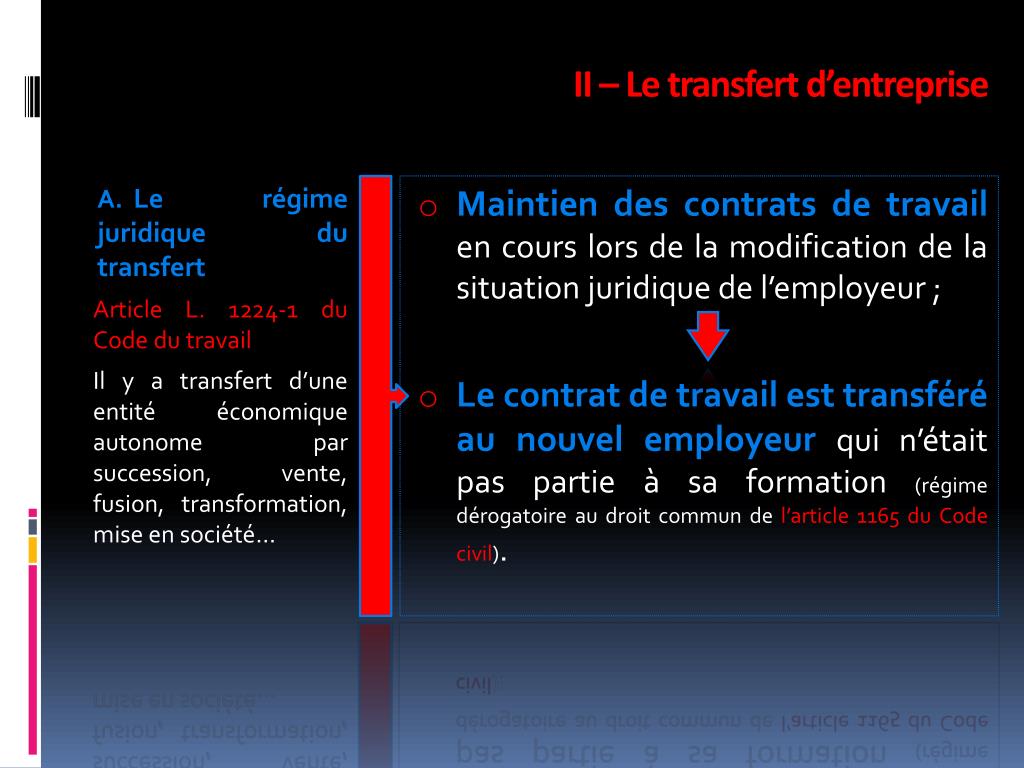
Okay, deep breath. Simply put, Article L1224-1 is the champion of employees during a business transfer. Imagine a company – let's call it "Fromage & Co." – gets bought by another, "Baguette Industries." What happens to all the poor souls working at Fromage & Co.? Do they get tossed aside like day-old croissants? Non! Article L1224-1 is here to ensure they (mostly) keep their jobs and their employment conditions.
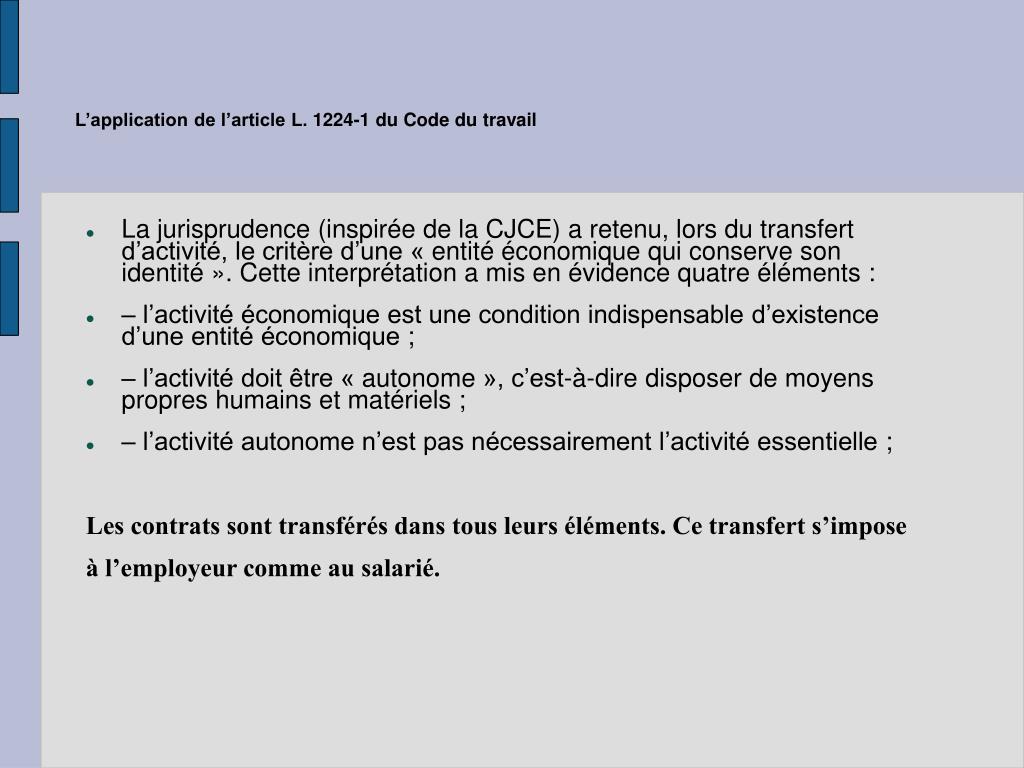
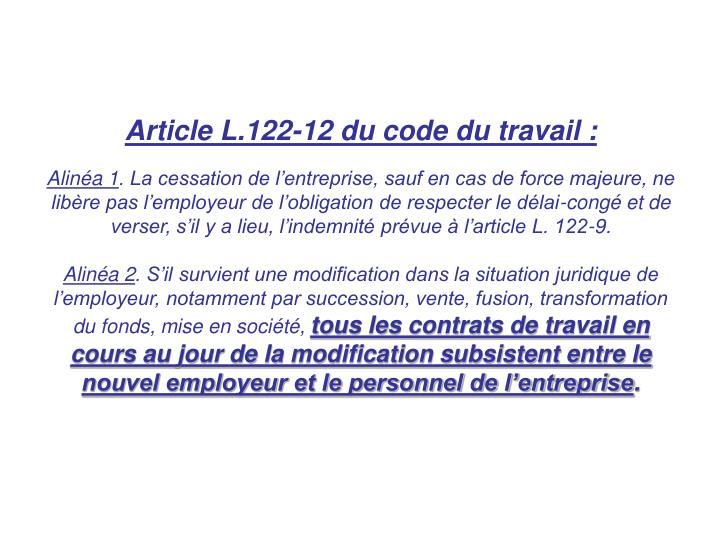
Essentially, it dictates that when a business (or a part of a business) undergoes a transfer of ownership, the employment contracts of the employees linked to that transferred business are automatically transferred to the new employer. It's like a magical employment portal that whisks you away to a new (hopefully better) workplace, keeping your rights and responsibilities intact. Think of it as the employment law equivalent of a teleportation device – except instead of turning you into a puddle of goo, it protects your job!
Must Read
The Nitty-Gritty: Key Concepts Decoded
Alright, let's break down the key elements of this legal masterpiece. Think of it as the ingredients for a surprisingly delicious legal soufflé.
- Transfer of an Economic Entity: This is the big one. It's not just about selling a company's assets. It's about transferring an organized group of resources that allows the pursuit of an economic activity. Basically, if you can still run the same business after the transfer, we're likely talking about an economic entity. Imagine a bakery – transferring the ovens alone isn't enough. You need the ovens, the recipes, the bakers, and ideally, a perpetually grumpy Parisian cashier to complete the picture.
- Maintaining Identity: The economic entity must retain its identity after the transfer. This doesn't mean everything has to stay exactly the same (Baguette Industries might want to introduce pain au chocolat, for example!), but the core business activity should continue. If Fromage & Co. transforms into a rocket launch facility after the transfer, Article L1224-1 might not apply. Unless, of course, they're launching cheese rockets… which, frankly, sounds amazing.
- Automatic Transfer of Employment Contracts: This is where the magic happens. Employees linked to the transferred entity automatically become employees of the new employer. Their seniority, salary, job title (hopefully!), and existing agreements are all supposed to follow them like well-trained poodles.
Who Gets to Ride the L1224-1 Train?
Not everyone gets a ticket to this employee-protection party. Let's see who's on the guest list:
- Employees with an Employment Contract: This is the obvious one. If you have a permanent (CDI) or fixed-term (CDD) contract specifically tied to the transferred business, you're almost certainly covered. Think of the cheesemonger whose entire job revolves around Fromage & Co.'s brie selection.
- Apprentices (Contrat d'apprentissage): Yes, even apprentices get the L1224-1 love. They're learning the ropes (or the cheese-making techniques) and deserve the same protection as everyone else.
- Employees "Affected" to the Transferred Entity: This is where it gets a little fuzzy. It's not always clear who is "affected" to a specific business unit. Courts often look at factors like:
- Functional Links: Does the employee's job directly contribute to the activity of the transferred entity? Is their work essential to its operation?
- Place of Work: Do they primarily work at the location of the transferred business?
- Direction: Who gives them instructions and manages their work? Is it someone from the transferred entity?
Imagine a graphic designer who spends 90% of their time creating cheesy (pun intended!) marketing materials for Fromage & Co. Even if they're technically employed by the parent company, they're likely to be considered "affected" and transferred along with the business.
What Happens After the Transfer?
So, you've successfully hitched a ride on the L1224-1 train. Congratulations! But what can you expect when you arrive at your new employment destination?
- Continuation of Employment Contracts: As mentioned earlier, your employment contract continues with the new employer. This means your salary, job title, seniority, and any other agreed-upon conditions should remain the same. Of course, Baguette Industries might eventually want to renegotiate your contract, but they can't unilaterally change it just because they bought Fromage & Co. That would be very uncivilized!
- Collective Agreements: This is where things can get a bit complicated. If Fromage & Co. had a collective bargaining agreement (convention collective), and Baguette Industries has a different one (or none at all!), there's usually a transitional period where the old agreement continues to apply. This period is generally 15 months. After that, the new employer's agreement (if any) will take over. This is a prime opportunity to brush up on your negotiation skills (or at least learn how to look convincingly concerned during union meetings).
- Harmonization: Over time, the new employer will likely try to "harmonize" employment conditions across the entire company. This might involve changes to benefits, work rules, or even job titles. However, these changes must be made in compliance with French labor law and cannot be used to unfairly disadvantage employees who were transferred under Article L1224-1. If Baguette Industries tries to make you wear a ridiculously oversized beret as part of the "harmonization" process, you have grounds to object! (Probably.)
Exceptions and Caveats: Because Life Isn't Always a Perfectly Baked Baguette
Now, before you get too comfortable, let's acknowledge that Article L1224-1 isn't a flawless shield. There are a few exceptions and situations where it might not apply:
- Bankruptcy or Liquidation: If Fromage & Co. goes bankrupt and is liquidated, Article L1224-1 usually doesn't apply. Bankruptcy proceedings are a whole different ball game, with their own set of rules and priorities. Sadly, protecting employee jobs isn't always at the top of the list in such situations.
- Voluntary Departure: If you decide to quit your job before the transfer takes place, Article L1224-1 won't save you. You're essentially jumping ship before it even reaches the new port. You're free to do so, of course, but don't expect the legal protections to follow you.
- Serious Misconduct: If you're caught stealing cheese or sabotaging the company's ovens, Baguette Industries can still fire you, even after the transfer. Article L1224-1 protects your job from the transfer itself, but it doesn't protect you from the consequences of your own bad behavior. So, resist the urge to replace all the salt with sugar in the croissants... tempting though it may be.
- Fundamental Change in the Business: If Baguette Industries drastically changes the nature of the business after the transfer, Article L1224-1 might cease to apply. For example, if they shut down the cheese-making operation entirely and turn Fromage & Co. into a call center, the employees whose jobs were specifically tied to cheese might be out of luck. However, this is a tricky area, and courts will carefully scrutinize any such changes to ensure they're not just a pretext for getting rid of employees.
The "Affected" Employee: A Case Study in Ambiguity
Let's dive a little deeper into that thorny issue of who is considered "affected" to the transferred entity. This is where legal battles are often fought, and where things can get particularly messy. Imagine a scenario:
Fromage & Co. has a small IT department that manages its internal computer systems. The IT department also provides support to several other smaller companies owned by the same parent company. When Fromage & Co. is sold to Baguette Industries, does the entire IT department get transferred? Or only the portion of the IT department that directly supports Fromage & Co.?
Here's how a court might analyze this situation:
- Time Allocation: How much time do the IT employees spend working specifically on Fromage & Co.'s systems? If they spend 80% of their time on Fromage & Co., it's a strong indication that they're "affected." If they spend only 20%, it's less likely.
- Functional Integration: Are the IT systems of Fromage & Co. completely separate from the systems of the other companies? Or are they highly integrated? If the systems are tightly integrated, it might be argued that the entire IT department is essential to the operation of Fromage & Co.
- Organizational Structure: Is there a dedicated IT manager who is responsible solely for Fromage & Co.'s IT needs? If so, that manager and their team are more likely to be considered "affected."
The court would weigh all these factors to determine whether the IT employees are sufficiently linked to the transferred business to warrant protection under Article L1224-1. It's a complex, fact-specific inquiry, and the outcome can be unpredictable. This is why it's always a good idea to consult with a lawyer if you're unsure about your rights in a transfer situation.
How to Protect Yourself: A Practical Guide for the Anxious Employee
Okay, so you're facing a business transfer and you're feeling a bit nervous. What can you do to protect yourself and ensure that your rights are respected? Here's a handy checklist:

- Stay Informed: Pay close attention to any announcements or communications from your employer regarding the transfer. Ask questions if anything is unclear. Knowledge is power, my friend!
- Review Your Employment Contract: Make sure you have a copy of your employment contract and any other relevant agreements. Familiarize yourself with your rights and obligations.
- Document Everything: Keep records of your work, your performance evaluations, and any communications related to the transfer. This documentation could be invaluable if you need to assert your rights later.
- Consult with a Lawyer or Union Representative: If you have any concerns or questions, don't hesitate to seek professional advice. A lawyer or union representative can help you understand your rights and navigate the complexities of Article L1224-1.
- Don't Panic (Yet!): Business transfers can be stressful, but try to remain calm and rational. Remember that Article L1224-1 is there to protect you. And remember, a little bit of cheese (or baguette) can always help soothe the nerves.
Beyond the Letter of the Law: The Spirit of L1224-1
While understanding the legal technicalities of Article L1224-1 is important, it's also worth considering the underlying spirit of the law. It's not just about ticking boxes and complying with the bare minimum requirements. It's about protecting the rights and livelihoods of employees who are often caught in the middle of corporate transactions that are beyond their control.
A responsible employer will not only comply with the letter of the law but will also strive to ensure a smooth and fair transition for employees. This might involve providing clear communication, offering training and support, and being willing to negotiate in good faith to address any concerns. After all, happy employees are more productive employees (and less likely to sabotage the croissants!).
L1224-1 in the News: Real-World Examples
Article L1224-1 isn't just some dusty legal concept. It pops up in the news all the time, whenever a business is bought or sold. Here are a few hypothetical examples:
- The Tech Startup Acquisition: "LocalTech," a promising software startup, is acquired by "MegaCorp," a giant multinational corporation. The employees of LocalTech are initially worried about job losses, but MegaCorp assures them that Article L1224-1 will be fully respected, and that their jobs are safe. However, some employees later complain about changes to their benefits and work conditions, leading to a legal dispute.
- The Restaurant Chain Takeover: "Le Gourmet," a popular chain of French restaurants, is bought by a US-based fast-food conglomerate. The new owners announce plans to "streamline" operations and introduce American-style menu items. The French chefs and waiters are outraged, fearing that their jobs and the authenticity of the restaurants are at risk. They threaten to strike, arguing that the changes violate the spirit of Article L1224-1.
- The Factory Closure and Relocation: "Fabrication Française," a manufacturing plant, is shut down, and its operations are moved to a lower-cost country. The employees argue that this constitutes a "disguised transfer" and that Article L1224-1 should apply. The company denies this, claiming that the closure is due to economic hardship and not a transfer of business. The case goes to court, and the judge must decide whether the closure was a legitimate business decision or an attempt to circumvent the law.
These examples illustrate the real-world challenges and complexities of applying Article L1224-1. Each case is unique, and the outcome depends on the specific facts and circumstances.
The Future of L1224-1: Adapting to a Changing World
The world of work is constantly evolving, with new technologies, business models, and forms of employment emerging all the time. This raises the question of whether Article L1224-1 needs to be updated or adapted to keep pace with these changes. For example:
- The Gig Economy: Does Article L1224-1 apply to independent contractors or freelancers who provide services to a business that is being transferred? This is a gray area, and the answer may depend on the degree of control and dependence that the business has over the contractors.
- Remote Work: If a company that employs remote workers is acquired, how does Article L1224-1 apply to those workers? Does their location matter? What if they live in a different country?
- Artificial Intelligence: As AI and automation become more prevalent, will Article L1224-1 need to be amended to protect employees whose jobs are displaced by technology?
These are just some of the challenges that policymakers and legal scholars will need to address in the coming years to ensure that Article L1224-1 remains relevant and effective in protecting the rights of employees in a rapidly changing world of work.

Practical Tips for Employers: Ensuring a Smooth Transfer
For employers navigating a business transfer, a proactive and transparent approach is key to ensuring compliance with Article L1224-1 and maintaining positive employee relations. Here are some practical tips:
- Conduct a Thorough Due Diligence: Before the transfer, carefully assess the employment contracts, collective agreements, and employee benefits of the transferring entity. Identify any potential liabilities or issues that may arise.
- Communicate Clearly and Early: Keep employees informed about the transfer process, including the timeline, the potential impact on their jobs, and their rights under Article L1224-1. Honest and open communication can help alleviate anxiety and build trust.
- Consult with Employee Representatives: Engage with works councils (comités sociaux et économiques) or union representatives to discuss the transfer and address any concerns. Collective bargaining agreements may require specific consultation procedures.
- Develop a Harmonization Plan: If you plan to harmonize employment conditions after the transfer, do so in a fair and transparent manner, respecting the acquired rights of the transferred employees. Consult with legal counsel to ensure compliance with labor laws.
- Provide Training and Support: Offer training and support to help transferred employees adapt to the new work environment and integrate into the new organization.
- Address Individual Concerns: Be prepared to address individual employee concerns and questions on a case-by-case basis. A personalized approach can help resolve issues and maintain positive employee morale.
- Seek Legal Counsel: Consult with an experienced labor lawyer to ensure compliance with Article L1224-1 and all applicable labor laws.
By following these tips, employers can navigate a business transfer smoothly, minimize legal risks, and maintain a positive and productive workforce.
International Perspectives: Comparing Transfer of Undertakings Regulations
While Article L1224-1 is specific to French law, many other countries have similar regulations designed to protect employees during business transfers. The European Union's Acquired Rights Directive (ARD) serves as a framework for these regulations in EU member states.
Here's a brief comparison of transfer of undertakings regulations in a few key jurisdictions:
- United Kingdom: The Transfer of Undertakings (Protection of Employment) Regulations 2006 (TUPE) implement the ARD in the UK. TUPE provides similar protections to Article L1224-1, including the automatic transfer of employment contracts and the protection of acquired rights.
- Germany: Section 613a of the German Civil Code (Bürgerliches Gesetzbuch - BGB) governs the transfer of undertakings. It also provides for the automatic transfer of employment contracts and prohibits dismissals related to the transfer.
- United States: The US does not have a federal law that directly addresses the transfer of undertakings. However, some state laws may provide limited protections for employees in certain situations. Generally, the principle of "employment at will" prevails, meaning that employers can terminate employees for any reason (or no reason) unless there is a contractual agreement to the contrary.
- Canada: Canadian labor laws vary by province and territory. Some provinces have legislation that protects employees during business transfers, while others do not.
This comparison highlights the varying levels of protection afforded to employees during business transfers around the world. France and other EU countries generally offer stronger protections than the US, reflecting different philosophical approaches to labor law and employee rights.

Common Mistakes to Avoid: A Word of Caution
Navigating Article L1224-1 can be tricky, and employers and employees alike can make costly mistakes. Here are some common pitfalls to avoid:
- Misclassifying Employees: Incorrectly classifying employees as independent contractors to avoid the obligations of Article L1224-1 can lead to legal penalties and reputational damage.
- Failing to Communicate: Neglecting to communicate with employees about the transfer process can create anxiety, distrust, and potential legal disputes.
- Unilateral Changes to Employment Conditions: Making unilateral changes to employment conditions after the transfer without proper consultation or justification can violate Article L1224-1 and lead to legal action.
- Ignoring Collective Agreements: Disregarding the terms of applicable collective agreements can result in labor disputes and legal liabilities.
- Failing to Seek Legal Advice: Attempting to navigate Article L1224-1 without legal guidance can lead to costly errors and non-compliance.
By avoiding these common mistakes, employers and employees can ensure a smoother and more legally compliant transfer process.
The Ethical Dimensions of Business Transfers
Beyond the legal requirements of Article L1224-1, there are also ethical considerations to keep in mind during a business transfer. Employers have a responsibility to treat their employees fairly and with respect, even when making difficult decisions.
Here are some ethical principles to guide business transfers:
- Transparency: Be transparent with employees about the transfer process and the potential impact on their jobs.
- Fairness: Treat all employees fairly and equitably, regardless of their position or tenure.
- Respect: Respect the acquired rights and dignity of transferred employees.
- Empathy: Understand the anxiety and uncertainty that employees may be feeling during a transfer and provide support and reassurance.
- Responsibility: Take responsibility for the impact of the transfer on employees and mitigate any negative consequences.
By adhering to these ethical principles, employers can create a more positive and humane transfer experience for their employees.
Conclusion: So, What Did We Learn?
Well, we've successfully navigated the labyrinthine world of Article L1224-1! We've learned that it's not just a dry legal text, but a vital tool for protecting employees during business transfers. It's about ensuring fairness, preserving jobs, and preventing corporate shenanigans. And while it may seem complicated at times, remember that the underlying principle is simple: don't mess with people's livelihoods! (Unless, of course, they're consistently serving stale baguettes… then maybe a polite word with the manager is in order.) So, the next time you hear someone mention Article L1224-1, you can confidently nod and say, "Ah yes, the employee-saving grace of French business law! Now, about that cheese…." Because honestly, after all that legal talk, you deserve a Camembert and a nap. À bientôt!